Welcome to NSMS
*
Welcome to NSMS *
Since our founding on March 22, 1996, the National Society of Medical Scientists (NSMS) has been dedicated to defining the future of healthcare science, technology, and development in the United States.
As a private, nonprofit 501(c)(3) institution, we operate independently of government influence to ensure the integrity of our mission: delivering rigorous, objective, and expert counsel on the critical issues shaping modern medicine. We invite you to explore our work at the forefront of scientific innovation and healthcare policy.
Welcome to NSMS.
Our Mission
To serve the nation by providing independent, objective, and evidence-based advice on advancements in healthcare science, technology, and development.
Our Members
The National Society of Medical Scientists (NSMS) is composed of more than 800 members, each elected in recognition of outstanding professional achievement in Future Healthcare Science.
Membership is highly selective: the NSMS elects no more than 100 members from the United States annually.
Our members are the backbone of the organization, contributing significantly to the work of the NSMS through volunteer service on:
Leadership and advisory bodies
Programmatic working groups
Key Leadership
T1: Clinical Domain
○ Leadership: June Lee, MD, PhD (Executive Deputy Director & Chief Medical Officer (CMO)
○ Contact: JLee@nsmsusa.org
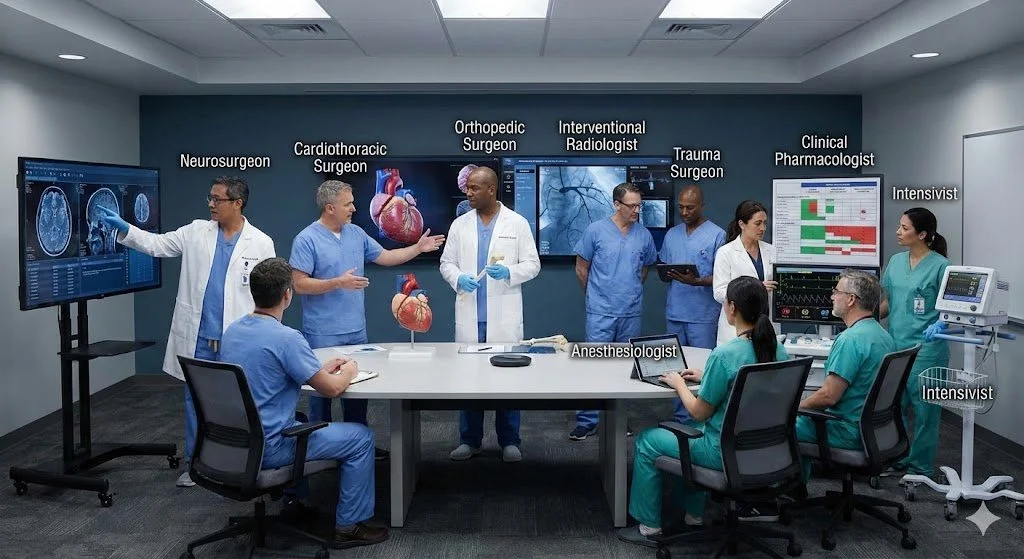
○ Key Expertise/Reports: Neurosurgeons, Cardiothoracic Surgeon, Emergency Physician, Intensivist, and Clinical Pharmacologists
○ Primary Function: Define medical standards and "teach" the AI.
T2: Robotics Domain
○ Leadership: Emily Brown, PhD (Director & Chief Engineer)
○ Contact: EBrown@nsmsusa.org
○ Key Expertise/Reports: Mechatronics, Haptics, Soft Robotics
○ Primary Function: Build the physical agents and sensors.
T3: AI/Compute Domain
○ Leadership: June Lee, MD, PhD (Executive Deputy Director & Chief AI Architect)
○ Contact: JLee@nsmsusa.org
○ Key Expertise/Reports: Computer Vision Specialists, Reinforcement Learning (RL) Experts, Data Scientists
○ Primary Function: Enable perception and decision-making.
T4: Governance Domain
○ Leadership: Christopher Johnson, PhD (Chief Regulatory Affairs Officer)
○ Contact:CJohnson@nsmsusa.org
○ Key Expertise/Reports: Regulatory Affairs Specialists, Bioethicists, Cybersecurity Experts
○ Primary Function: Ensure safety, legality, and trust.
T5: Programs
○ Leadership: Minda Miller, MD (Program Manager)
○ Contact: MMiller@nsmsusa.org
○ Key Expertise/Reports: Program Coordination
○ Primary Function: Manage autonomous healthcare programs.
T6: Legal
○ Leadership: Jason Jones, JD (Chief Legal Officer / General Counsel)
○ Contact: JJones@nsmsusa.org
○ Key Expertise/Reports: Regulatory Compliance, Patents
○ Primary Function: Handle IP protection and corporate legalities.
T7: Finance
○ Leadership: Amy Griggs, CPA (Chief Financial Officer)
○ Contact: AGriggs@nsmsusa.org
○ Key Expertise/Reports: Accounting, Investor Relations, Treasury
○ Primary Function: Manage financial health and funding.
T8: HR
○ Leadership: Maria Davis, MBA (HR Director)
○ Contact: MDavis@nsmsusa.org
○ Key Expertise/Reports: Recruiting, Training, Employee Relations
○ Primary Function: Manage talent acquisition and culture.
Our Current Work
Informing Autonomous Healthcare
We draw on rigorous evidence and research-backed analyses to inform the development of effective autonomous healthcare systems.
Driving Collective Action
.We foster public-private collaborations and collective action to achieve common goals for healthcare advancement.
Addressing Critical Challenges
We lead nonpartisan initiatives and collaborations focused on resolving critical challenges in the evolving field of autonomous healthcare.
Our Autonomous Healthcare Expert Team
T1. Clinical Domain Experts (The "Teachers" & Supervisors)
Lead: Dr. June Lee, MD, PhD, Executive Deputy Director and Chief Medical Officer (CMO)
Email: JLee@nsmsusa.org
These experts define the "ground truth." They provide the medical knowledge, surgical techniques, and decision-making logic that the AI must learn.
● Surgical Specialists:
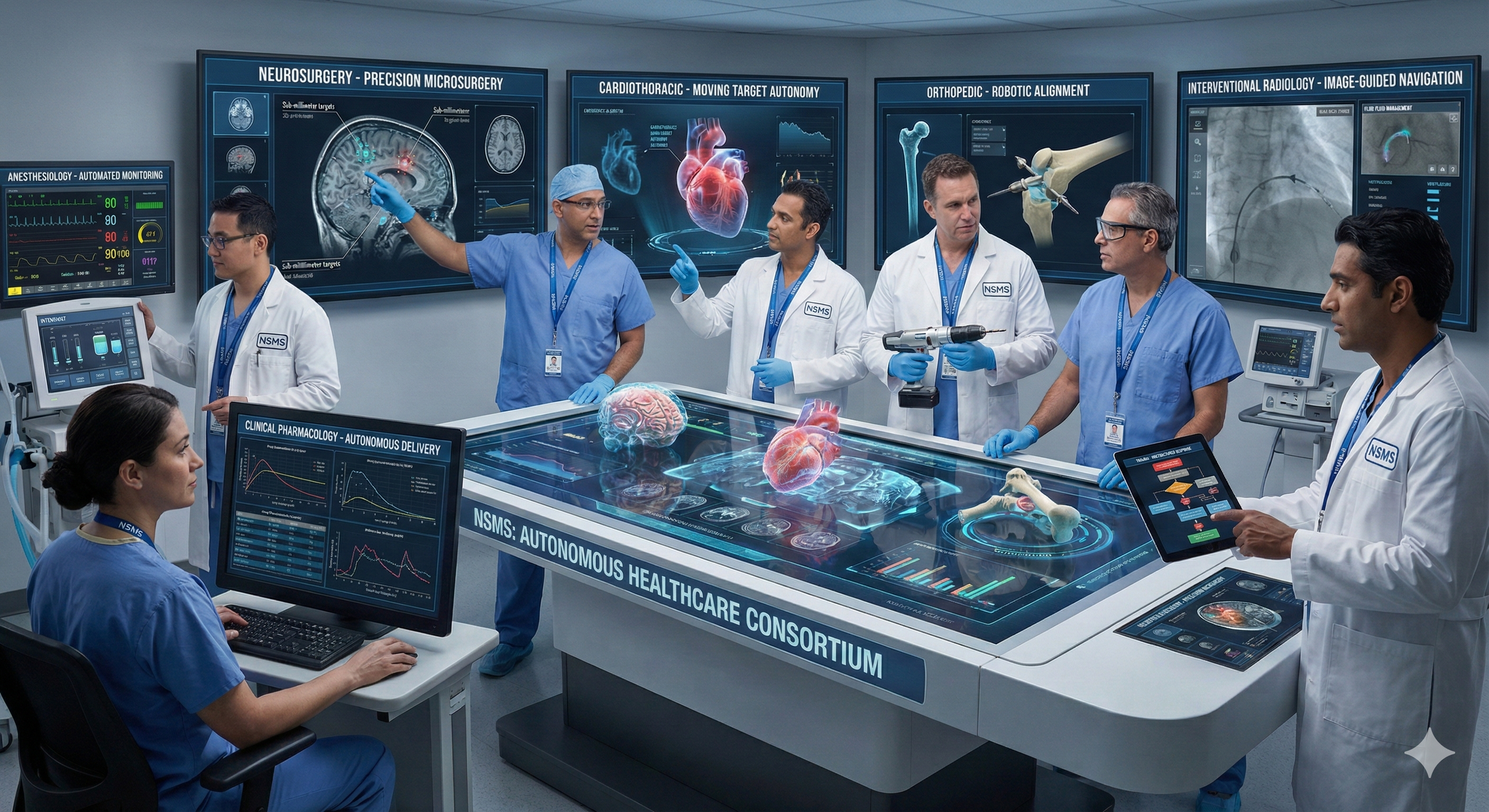
○ Neurosurgeons: Crucial for high-precision, microsurgical tasks (e.g., tumor removal, aneurysms) where the margin for error is sub-millimeter.
○ Cardiothoracic Surgeons: Essential for autonomous systems addressing moving targets (beating hearts) and complex vascular reconstruction.
○ Orthopedic Surgeons: Needed for robotic bone handling, drilling, and implant alignment (already a mature field in robotics).
○ Interventional Radiologists: Experts in image-guided, minimally invasive procedures. Key for teaching robotic navigation via catheters and needles.
○ Trauma Surgeons: Vital for designing systems that can handle "unstructured" emergencies where speed and adaptability are critical.
● Medical Treatment Specialists:
○ Clinical Pharmacologists: Essential for defining autonomous drug delivery algorithms, managing drug-drug interactions, and pharmacokinetics (how the body processes drugs in real-time).
○ Anesthesiologists: Required to automate sedation levels, pain management, and vital sign monitoring during autonomous procedures.
○ Intensivists (ICU Doctors): For designing systems that autonomously manage life support, ventilators, and fluid resuscitation.
Our Autonomous Healthcare Expert Team
T2. Technical & Robotics Engineering (The "Builders")
Lead: Dr. Emily Brown, PhD, Director and Chief Engineer
Email: EBrown@nsmsusa.org
These experts build the physical hardware that interacts with the patient.
● Mechatronics Engineers: Design the robotic arms, end-effectors (tools), and actuators that mimic or exceed human dexterity.
● Haptics Engineers: Specialists in "touch" technology. They enable the robot to "feel" tissue density, identifying the difference between a nerve, a vein, and a tumor.
● Bio-MEMS Engineers: (Micro-Electro-Mechanical Systems) Create microscopic robots or sensors (like "smart dust" or nanobots) for internal treatments.
● Soft Robotics Engineers: Focus on making robots out of compliant materials that are safer for human contact and can navigate delicate tissue without damaging it..
Our Autonomous Healthcare Expert Team
T3. AI & Computational Experts (The "Brains")
Lead: Dr. June Lee, MD, PhD, Executive Deputy Director and Chief Healthcare AI Architect
Email: JLee@nsmsusa.org
These experts build the software that perceives the environment and makes decisions.
● Computer Vision Specialists: Build the eyes of the system. They train models to segment anatomy (e.g., "this pixel is liver, this pixel is an artery") from camera feeds, MRI, or CT data.
● Deep Reinforcement Learning (RL) Experts: Train agents to make sequences of decisions (e.g., the best path to cut) by simulating millions of surgeries.
● Medical Data Scientists: Clean and annotate the massive datasets required to train the AI (scrubbing noisy hospital data).
● Sim-to-Real Engineers: Specialize in ensuring that what a robot learns in a physics simulator (virtual world) translates accurately to the messy reality of a human body.
Our Autonomous Healthcare Expert Team
T4. Regulatory, Safety & Ethics (The "Guardrails")
Lead: Dr. Christopher Johnson, PhD, Chief Regulatory Affairs Officer
Email: CJohnson@nsmsusa.org
Autonomous healthcare faces extreme scrutiny; these roles ensure the technology is legal, safe, and accepted.
● Bioethicists: Address the moral dilemmas of autonomous care (e.g., "Who is responsible if the robot makes a mistake?").
● Regulatory Affairs Specialists (FDA/EMA): Experts in the specific pathways for "Software as a Medical Device" (SaMD) and autonomous surgical robotics approval.
● Medical Cybersecurity Experts: Protect the system from being hacked. (A hacked autonomous surgeon is a lethal weapon).
● Human Factors Engineers: Design the interface between the human oversight team and the autonomous robot to prevent "automation bias" (where humans trust the robot too much and stop paying attention).
Innovations
Redefining the Future of Autonomous Medicine
At NSMS, we don’t just build machines; we engineer Self-Evolutionary Healthcare ecosystems. Our 2026 innovation roadmap focuses on bridging the gap between clinical diagnostics and rapid-response robotics, ensuring that expert-level care is available anytime, anywhere. Our Breakthrough Research Areas:
Key Recently Granted & Active NSMS Patents
1. 12283378: PROVIDING HEALTHCARE VIA AUTONOMOUS, SELF-LEARNING, AND SELF-EVOLUTIONARY PROCESSES. USPTO Link:https://image-ppubs.uspto.gov/dirsearch-public/print/downloadPdf/12283378
2. 12499995: AUTONOMOUS MEDICAL RESCUE ROBOTS AND TEAMS. USPTO Link: https://image-ppubs.uspto.gov/dirsearch-public/print/downloadPdf/12499995
3. 12496713: AUTONOMOUS AND SEMI-AUTONOMOUS MULTIFUNCTIONAL MEDICAL ROBOTS, TEAMS, AND SYSTEMS. USPTO Link:https://image-ppubs.uspto.gov/dirsearch-public/print/downloadPdf/12496713
4. 12437872: AUTONOMOUS MEDICAL SCREENING AND RECOGNITION ROBOTS, SYSTEMS AND METHOD OF IDENTIFYING A DISEASE, CONDITION, OR INJURY. USPTO Link:https://image-ppubs.uspto.gov/dirsearch-public/print/downloadPdf/12437872
5. 12653464: AUTONOMOUS HEALTHCARE VISUAL SYSTEM FOR REAL-TIME PREVENTION, DIAGNOSTICS, TREATMENTS AND REHABILITATION. USPTO Link:https://image-ppubs.uspto.gov/dirsearch-public/print/downloadPdf/12653464
Major Technology Areas
NSMS's active patents are concentrated in the following areas:
Self-Evolutionary Healthcare Systems: Autonomous, self-learning processes designed for continuous healthcare delivery and system evolution.
Autonomous Medical Rescue Teams: Deployment of coordinated robotic units and teams specifically for emergency medical rescue operations.
Multifunctional Medical Robotics: Autonomous and semi-autonomous systems capable of performing diverse medical tasks within integrated clinical environments.
Autonomous Screening & Diagnostics: AI-driven recognition systems for the automated identification of diseases, medical conditions, and traumatic injuries.
Real-Time Healthcare Visual Systems: Advanced visual processing for real-time prevention, diagnostics, surgical assistance/treatment, and rehabilitation.
Shape the Future of Care with Us
The bridge between advanced robotics and clinical excellence is built through collaboration. We are looking for visionary partners, developers, and healthcare institutions to bring our autonomous systems to the front lines of medicine.
Join Minda Miller, MD, and the NSMS team as we develop the next generation of self-evolutionary healthcare. Together, we can ensure that the future of medicine is smarter, faster, and accessible to all.
Working Togather
Interested in working together? Fill out some info and we will be in touch shortly. We can’t wait to hear from you!
Email: nsms@nsmsusa.org